Wednesday, 29 July 2015

Is it worth it - all this bloody Blogging?

I still react to the end of school terms, especially at the start of summer, even though the last time I was in school (full time) was 10 years ago.  I respond to the imagined freedom to just do what I want, when I want, how I want.  Good old Dodo, my wife, allows a great deal of that freedom - she knows it will also include mending broken bits of the home and fettling..

So far, I've been building a Tree-House (see BLOG below), playing the piano, mending locks, making a swing, climbing a few Wainwrights, helping daughter and son-in-law move house, writing, swimming, lurking around the internet, working with some great colleagues on iAbacus www.iabacus.co.uk developments and shrinking my website www.johnpearce.org.uk as I concentrate on iAbacus...

BUT I've also been spending time listening to and reading about very tired heads and teachers at their, real, end of term... and that has made me think about life as a young teacher.


I remember I hated marking because I failed to understand how it was beneficial in terms of time spent... So, I wrote about me as a young teacher, with energy and hair, but in despair and 1973.  All together now... "Ahhh..."
I wrote about having classes of 34+ and how my sense of humour kept me going but also led me to uncover two key elements of my developing career - the importance of feedback and (in the absence of that) how self evaluation helps.
My full BLOG is here: http://staffrm.io/@john/SvsVvjB7KT
I'm wondering now - if these reminiscences are of any value at all - Is all this bl**dt Blo**ing any use?  At least there is a swing now and our locks work..

Friday, 17 July 2015

A princess or a builder?

This is an extract from a fuller article published here #staffrm


I'm building a Tree House and being childlike, not childish. There's a difference.  Like being a girl but not "girly" I'm thinking this morning.  Let me explain a Granddad's use of those inverted commas and why I am worried about my relationship with Granddaughter Esther.  You can see her with a saw, at the foot of the tree...
I didn't notice her when I took the photo.  She's 3 and using a large screwdriver to remove a growth from the trunk. She has also been hammering nails, measuring, sawing and carrying heavy wood and climbing an aluminium ladder to 3 metres. She is very different here, in Bob the Builder mode (why not Belinda the Builder?) than when she is in Frozen Princess mode....
In Frozen mode and, "What I call.. (echoes of Miranda's Mum I fear?)... girly" mode she dresses in sparkly shoes, long princess skirt, paints her nails and wears Granny's necklaces. And she is more demanding, aloof and, yes.... strong willed. 
Here's the rub. I have some concerns about My Frozen Princess. Actually, go on, I'll admit it, I dislike this emerging Prima-Donna. So, what prejudices are scribbling all over Esther's three year old, wonderfully open canvas?
I could have built the Tree-House for My Little Princess, whilst she watched from her throne but I decided to challenge the status quo. It took a little persuasion to lure her out of Princess mode at the start. Why is this an issue for me? Because I fear she will be lured back by more powerful others to her sparkly castle. The media, peers, even school perhaps. Or, is this more about me wanting a Tomboy Granddaughter? Is that why I talk of mountains, trekking and building things? Is that why I let Granny do the nail painting and the jewellery stuff? But I fear her becoming glamourised, sexualised, a twerking child fashion model... And then again, I do wear a Leaf medallion, two gold rings and sport one sparkly toenail. Esther painted it 3 months ago. Why do I feel the need to explain that toenail at the gym?
Yes, we all, that is Sam and Sarah, Esther's parents, and Granny are up for this challenge. So, she's often transformed and redressed in sensible footwear, sans bling. She becomes my builder's mate and drops happily into apprentice mode - adding her ideas too! But she does my bidding, listening to instructions and they are strict. Remember we are balanced up high - her father looks happy but he's unsteady up there - and these tools are dangerous! She watches me sharpen them on a high revving grindstone in the workshop. Then later she's in that damned princess costume and looking at me as one of her subjects....
This is the look I treasure!

I'm, trying to redress, literally, the pull to her becoming girly but writing and reading this I can see a blot on my own canvas but publish and be damned I think. Hence the hashtag #womened 
POSTSCRIPT: A week later and another day with Esther and after all the feedback I am sure, very sure, that all will be well.... I am reflecting now that my fears we well meant but I had underestimated the power of Sam and Sarah her parents (who took me to task for over-thinking) and daughter Hannah (Esther's Aunt) who I know is on the case.  They are far better equipped to steer her course... and little sister Ruth's too...

It's the others I fear  - there is a lot of pressure on Early Years girls - ironically from peers. But my biggest sense is that I seemed to be arguing either Princess or builder (my blot I wrote) many have simply argued, "why not both?" I'm reassured by that..... And yet, we really shouldn't have to be banging on about sexism and stereotyping - there is so much to do. I want the petty bigoted pigeon holing of women to just go away! Overthinking again?


Tuesday, 30 June 2015

New Ofsted Framework 2015

A School Improvers' Charter?


My main BLOG on the New Ofsted Framework is on the iAbacus website www.iabacus.co.uk/blog but here are the headlines....


The new Ofsted Framework for September 2015 has:
  • lifted the “Effectiveness of Leadership” to the top position in Areas for Judgement
  • fully recognised the relationship between self-evaluation and action to lead and maintain improvement.
  • decided that when a school is good it will only need a light touch inspection and if outstanding it may even be exempt
  • will leave untouched professionals with a proven capacity in order to focus on settings requiring improvement. There is even a promise to, “offer more support”. 
  • signified a move to a System Leader role where inspection and support are purposefully entwined
  • continued the current inspection regime for schools previously judged Requires Improvement or Inadequate.
The critical measure in the new inspection process is clearly, “leadership’s capacity to drive improvement”  


Most significantly there appears a real attempt to work with colleagues in schools and move to a professional development approach signalled by: the re-emphasis on the removal of Lesson Grades; the involvement of senior staff in observations and the strengthening of feedback to individuals and groups.This means that the cycle of school improvement from vision through evaluation to CPD is completed. No more separate SEFs and SIPs as Self-evaluation, Analysis and Action Planning link in a continuous and virtuous circle.
For more on the detail go to www.iabacus.co.uk/blog

Conclusion

I feel really optimistic because I’m hoping leaders with capacity will seize this opportunity to save time and reduce bureaucracy for staff.  Heads can now write succinct, simple, school improvement plans on a few pages of A4 but I'm also hoping that the new iAbacus website (due to be launched this week) will show more than our current 1,000 users that "developing a staff's capacity to self-evaluate and drive improvement" is best achieved by using the iAbacus.
It's go to be the most effective way to create straightforward, secure, on-line, collaborative plans which can be accessed anywhere, anytime. The iAbacus was designed by and for those who want to, “look at what they do with a view to doing it better” and “do it simply”.  I'm pleased that Ofsted are, at last, coming round to the same view....
iAbacus on-line School Improvement Evaluation and Planning tool www.iabacus.co.uk


Wednesday, 18 February 2015

CPD - Taming the beast of unreasonable expectations


CPD Activity
Taming the unreasonable beast of unreasonable expectations

I'm celebrating 45 years in the education profession this year, an old dog now, one who's successfully survived most jobs in teaching, leadership and school improvement see CV  and I still love my work.  Most my contemporaries were glad to escape the treadmill, years ago.  All said they’d never experienced such unreasonable expectation.  And, oh dear reader, I hear you groan, "When I'm his age, retirement will be years away.  How will I survive?" Has this old dog one new trick for you?


In formal mode

A New Trick from an Old Dog?

I smashed out a RANT, on your behalf, in my last but one BLOG about the pressure in our profession See: "The Emperor is wearing too many clothes" . I promised to write more positively about all this but I went away on a trek and came back looking like this...


Informal mode
(Knowing when to get some space is one of this Old Dog's tricks.)  I regained my sense of perspective on that trek.  I wrote about what I learnt in Nepal See "A Deeper Sense of Knowing"

When I came back I began work on my positive ADVICE, a CPD Activity for ONE and an OFFER -  here they are....


ADVICE
Kill the myth of the Super-Teacher
Killing the myth of the Super-Teacher is your first task.  Working with a hall-full of NQTs in Lincolnshire recently (What is the collective noun for NQTs?) I realised many thought they had to teach outstanding lessons, every lesson, every day, every week.  We all know that’s nonsense but I sense the expectation lurks deep in our collective sub-conscious. Just read all the chest bashing and guilt about workload and cries for teacher "Well-Being"...  Cue a rendition - See "Superhead's Conference Address" written in 2002 but as funny, pathetic and true today as ever. 

Beware these self-professed Super-teachers  (you can read the BLOGS). They care like all that do our work do, but they are toxic, self-deluding and unrealistic role models, who try to do it all, “make it complicated and don’t stand a chance”.  Read down the page  see "The Decision"  to find what happens.  They become the loners who drink in excess, take drugs and time off with a “Bad back” or “Virus”.  It’s cruel but it’s true.  I’ve seen it, even been it and survived it and am stronger for it.  Resist the temptation to become one. Kill this myth before it kills you.

Learn to do less well rather than more badly
Over my 45 years in the job, I’ve seen the people who succeed, not just in education, and I now know how they do it.  They’ve tamed the beast of unreasonable expectations. You’ll see they are not super-human, they are ordinary people with immense willpower who, “do less well rather than more badly”.  They take the longer view, prioritise, focus and act.  They, “know their ONE priority”, so they say, “No”, to other temptations, in order to say, “Yes” to the priority of the moment.  They’ve smelled failure and have come back from the brink, with a steely, single-mindedness and unremitting moral purpose. They reject independence preferring interdependence, knowing the power of cooperation and how to create the permitting circumstances for others to understand and join them.  

Watch them and learn as I did. You’ll see they are strategic. They have powerful processes and systems. They keep it simple, knowing it'll get complicated anyway.  I have used all of their processes, including: action research, coaching, self-evaluation and performance management and spent years merging and honing the best into my own simple model.  I’m going to describe one CPD-ACTIVITY for ONE, from that model - an activity I guarantee will work – an activity that is, by far, the best evaluated aspect of all my work.


An SLT doing the activity in January this year


CPD ACTIVITY for ONE
Take the longer view, prioritise, focus and act.

1.  Book a quiet room, with chair(s) and table, for one hour, ideally away from work.
2.  Take in, only, a few sheets of A4, A3 or flipchart paper, a pen, pencil and, if you wish a red and green crayon.  This activity utilises your nous – the practical intelligence, intellect and information you “know” about your personal and professional circumstances.  So, leave all work material and electronic devices outside.
3.  Concentrate by reminding yourself that this process will make a difference by: simplifying complexity; focussing effort; analysing key factors; acting to make progress in an area of significant importance – your priority area.
4.  Take one sheet of paper and list all the KEY ELEMENTS of your work, down the left hand side.  These are the things you are responsible for, your work areas, but add in concerns too.  A typical list might be:  Achievement, Behaviour, Staff Morale, My Work Life Balance, State of Buildings, Finances, The Team.  You can use Ofsted/Teacher Standards, or other criteria, or objectives from plans and reports.  Just list all that comes to mind.
5.  Put three headings across the top of your sheet from left to right and label them:  Awful (or below expectations/unacceptable) – OK (or meets expectations, satisfactory, ) – Brilliant (or exceeds expectations, excellent)
6.  Now draw a horizontal line from each of your Key Elements across the page.  It will look something like this:


7.  Read down your list and put a cross on the line, indicating how you judge performance in this Key Element, from “Really Awful” i.e. far left to “Stunningly Brilliant” i.e. far right.  I use lines, not table boxes, to ensure gradation, so take time to work through the relativity of the positions of the crosses.
8.  Review the table you have drawn and consider the following:

  •         The crosses to the right are successes – these can be ticked, or coloured green, and left alone, they are not priorities.  You ought to thank lead colleagues responsible for their brilliance, if you haven’t already done so and celebrate any personal success here.  You can also leave the central OK crosses, for later, they are not priorities.
  •        The crosses to the left indicate your greatest concerns. Mark each with a question mark, or red pen.  You can ignore any you have no direct control over but you ought to alert lead colleagues to your concerns.
  •       Review the remaining crosses to the left.  They will not be of equal magnitude but they will contain your priority.
  •        Think carefully, decide the priority order and number them 1 to 4. Only number 1 will be considered in this session.
9.  Now take a second sheet of paper and write your priority, Number 1, at the top and draw a vertical line down the middle of the page.
10.  At the top of the left write HELPS and at the top right HINDERS.
11. Now write in actual people, information and resources that have HELPED, or HINDERED progress in this Key Element. Then, add actual people, information or things that might yet HELP, or HINDER, progress. If what you write is vague, e.g. New Staff, or Behaviour, split that “force” into sub elements and challenge yourself to name names and specify actual issues. Your sheet will look something like this..


12.  When you have identified all the forces that are, or could be, exerted, your next task is to prioritise these too. So, number the forces, be they helps or hinders.
13. It's obvious that progress will be made as HELPS gets stronger and the HINDERS weaken.  So, your penultimate task is plan to increase the priority HELP or decrease the priority HINDER (at best you combine both) So, you take your third sheet of paper and write up a Planning Strip for your priority force.  This could have a number of formats but is likely to contain common elements.  A Planning Strip to reduce the hindering force of “Parental Support in some groups” by harnessing the helping force of new staff Mike and Jo might look like this:


14.  The action taken is likely to make a difference and later, planning strips can be completed for other priority forces to increase progress in this area. You can, of course go back to other Key Elements and follow the same process.
15.  Your last task is to implement the action and evaluate impact.

Developing the CPD - The iAbacus
I improved this CPD-ACTIVITY by using my kids’ abacus and asking colleagues to slide the beads, instead of drawing crosses on paper.  The visual image was compelling, sliding the bead was cathartic.  The Planning Strips, detailing one action were a revelation.  As a senior leader I used to say to colleagues, “Don’t turn up with worries and problems, come with ideas to help”. I kept a store of Planning Strips and when a concern was raised I’d often say, “OK, let’s work on who will do what to sort this”. The strips fitted together and became our full plans.  It was all about taming the beast of unrealistic expectations.


Two potential priorities on this iAbacus


That abacus became my “New Trick” my simple process, applied to any area of endeavour.  In 2010 I met Dan O’Brien and we designed the on-line iAbacus.  It is now a unique self-evaluation and action planning tool and our users love its deceptive simplicity.  You can explore  iAbacus here see a Video here read primary and secondary school testimonials here and interrogate the theory and research behind it see iAbacus Model here   So, what’s the offer?  As you’d expect it’s simple....


THE OFFER - One bead to rule them all
Part One:
Take an iAbacus 30 day free trial here (no tricks involved) I promise it will help you, “Know your ONE priority” by finding the one bead to rule them all.  It will guide you through the process of prioritise, focus, act.  It will also, compile a report, offer clear sets of criteria for your judgements, help collaboration and much more.  Once used you’ll want to apply it elsewhere... Above all it will do it all simply... within minutes you’ll be up and running.

Part Two:
Save a PDF or WORD iAbacus report of your work on the trial, email it to me at john@johnpearce.org.uk  and let me know one area of work you want to improve and we'll set you up with a free year’s licence to continue the process you started in your trial. (This is worth £100)


Finally:
Woody Allen once said, “Life is tough and then you die” Leonardo Da Vinci said, “Simplicity is the ultimate sophistication”  I'm with Leonardo.   My honest hope is that the simple and sophisticated iAbacus will become your New Trick and help you: sort your professional approach and tame the beast of unreasonable expectations.  There’s even a Health and Well-Being iAbacus – why not use it to ensure you become a fit and enthusiastic old dog? 


My Old Dog - Jasper
who teaches me to relax


Wednesday, 19 November 2014

Learning from Nepal


A deeper sense of knowing - cherishing the simple good things we can do...

In my last BLOG, before my Autumn 2014 vacation, I ranted on about overcomplexity and called for simplicity.  In this BLOG I am trying to get closer to what I mean..

Last week I returned from a trek in Nepal amongst the furthest and highest Himalaya.  It was, as they so often are, a life enhancing experience.  Here I try to explain why....

From the Monastery in Samagoan

On our penultimate day I wrote....   Our Manaslu Trek is almost over and it's quiet, for once this night – no dogs barking.  We are in Bhule-Bhule, suddenly and surprisingly, in the midst of a huge Chinese hydro electric project, plonked in the midst of this beautiful valley.  Which valley isn't beautiful here?  We have been saying how there is massive potential and there certainly is need for such a development but having this ugly industrial landscape intrude is an assault on our senses, after the quiet, terraced subsistence farming we have witnessed and lived within.  It is quite distressing.  Of course it's good for the country but it's a worry we might lose some of this special place. So, what has been so special?

Collecting water

It has been like turning back time.  Like being returned to a naive boyhood - which I have deliberately never left – in which I saw things, as though for the first time.   I prize being childlike in my outlook – it’s about being open, enquiring, divergent and exploring – about looking for new things everywhere and anywhere and asking, “Why?”  So, on the Manaslu Circuit, for nearly a month, I think I have seen something missing in much of the supposed developed, or modern world.  It seemed at first to be about kitchens and women but you’ll see it was also about monks and temples. I’m not entirely sure yet but I think it’s about having a better sense of hearth, home and community... 


The Blue Lake
Cold but refreshing


Typical smile and typical rice terracing

Manaslu and the glacier

The trek was stunning. It has outclassed Dualigiri in many ways - more varied scenery - more beautiful - grander and our company has mixed and fitted together so well.  One of our team turned back at the pass, as many did, not trusting his skills and strength, and retraced his long steps, back down to Jaggat.  It will have taken him longer, but we all knew it was the right decision and part of each of us envied that retracing because the first valley was awesome, wide, finely carved by glacier and cut by thundering waters and falls.  Every niche was crammed with foliage, on the approach to clean, white, grey-blue, snow and ice.  Any approximate level had been terraced for rice, maize, wheat and potatoes between dotted medieval stone villages, increasingly ringed with inventive modern dwellings in a variety of wooden, corrugated iron, bamboo and poured concrete figurations. 

Arughat Bazar

Yak Kharka

The tea houses were wonderful and, at best, the hub of each village.  Their hearts were the wood fires in the kitchens. These dark glowing places touched our deepest emotions, for here strong, always smilingly, women worked wonders with local produce - rice, flour, vegetables and meats over their wood stoves. There is bottled gas and electric, of a quaint kind but those iron, welded home-made wood stoves held a special warmth that drew the folk to them.  And what warmth!  And what folk!

Another warm hearth

I've many tales to tell and pictures to show but these kitchens were the heartbeat of the trek and are probably the heartbeat of Nepal.  They go to something we have almost lost in our modern, developed world. Those fires draw in and literally capture, the communal life of the place.  Of course we have kitchens, real and magazine versions. We have splendid, pristine, designer kitchens, but very few do what each one of those we visited did - welcomed the community, the travellers, the hungry and inquisitive. Even the lonely, otherwise outcast Yak herder, with a unique personal hygiene was welcome here.  On one occasion a horse poked his head through the open door and I would not have been surprised had he entered and been fed.  On another, a black goat totted in dog like with a woman, shat on the floor, left quietly and no one seemed concerned. 
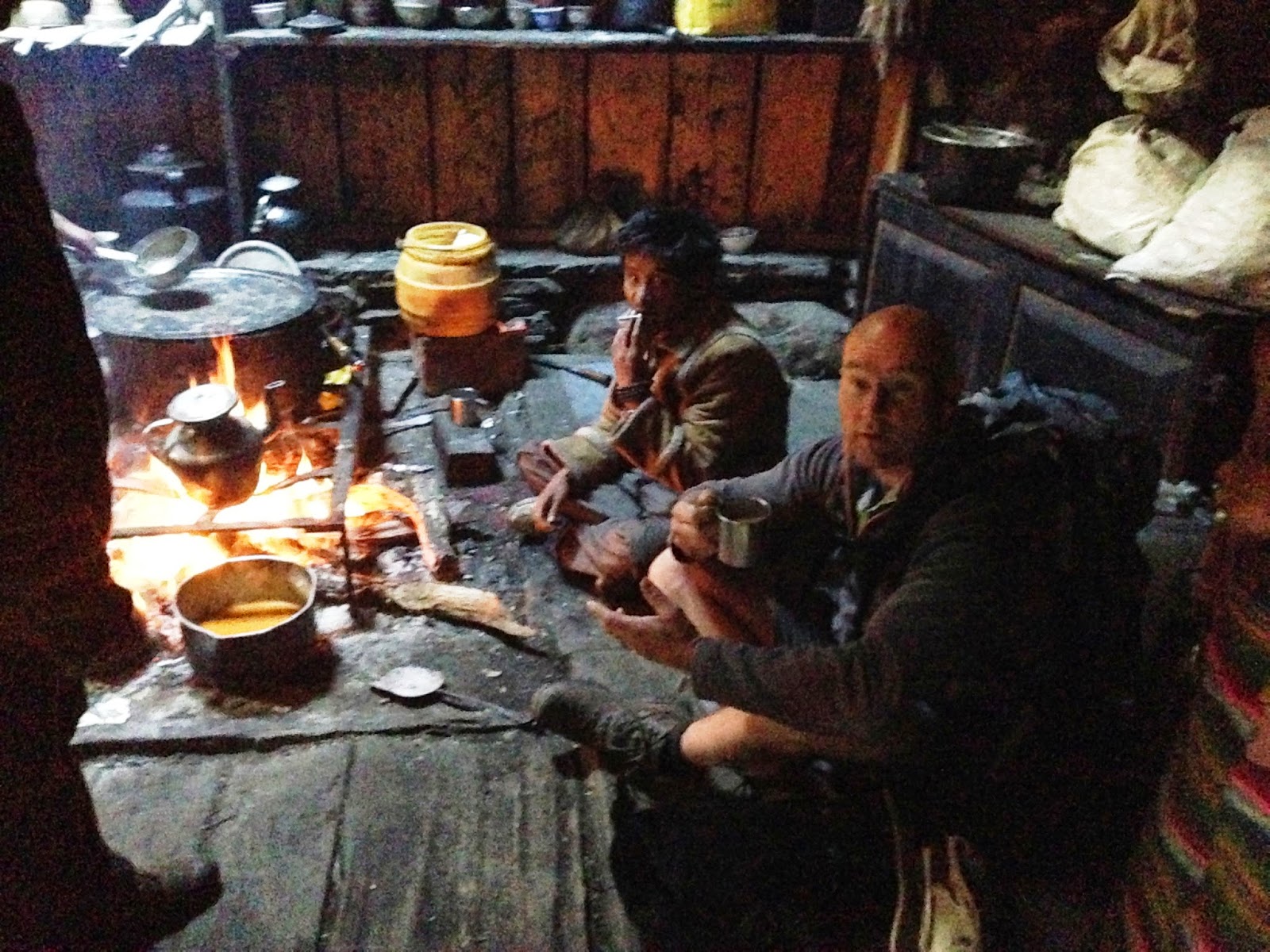
Typical Kitchen

Yes, there is dirt, natural dirt, human and animal dirt but I saw no illness - amongst locals at least. We were all careful with our filtered water and alcohol sanitizers and our group seemed fine apart from a circular cold, sore throat and chesty cough.  I evaded it but it almost scuppered a friend’s summiting but antibiotics, a day's rest and various other medications saw her scampering over the summit pass - with me the weakest of the group at a breathless rear.  It was tough, took all my strength and I could find no reserve in that thin air but hey ho, it felt good and I would not have missed it for the world. And, as always, clambering down from 17,000 feet it’s increasingly energising as you inhale the thicker, oxygen richer, air.

Larkya Lar 5160 metres

Manaslu Glacier

Bimtang

So, back to the world, our world, we come, refreshed, revitalised and startled by its reality, no better exemplified than by the monster Hydro Electric Plant.  But we have been reminded of what a world can, or could be.  I've been thinking for a long time about a deeper sense of knowing – my last BLOG was about the senseless complications we have clothed and hobbled ourselves with.  In this BLOG I'm trying to find a simpler way forward. That's what I meant by the trek enhancing my life.

Children at Samdo

I know I'll despair on returning home and that I still struggle to see - even by coming this far - what some have always, instinctively known.  It may seem daft for some who read this next bit but I think mothers would understand better than most.  Mothers would fit in here in unnoticed - they'd assume their place and, with that surety they often have (and people know they have) be a powerful part of it.  I am trying to be very careful here - there is no intent of patronage or sexism.  I am trying to get at that deeper sense of knowing, about a maternal nous.  DH Lawrence got close.  Dare I say that mothers, women who think like mothers and even the fewer men who think maternally run the machine of our world?  They know, deep down, it’s about driving the engine of family, of community,  It’s about ensuring the lower levels of Mazlov’s hierarchy are in place – keeping the warmth, the food, the relationships going.  I know I’m struggling to explain it  - better I try to describe it and how I saw it working, back in those kitchens.

Kitchen at Samdo

It was a privilege, we all recognised and spoke of, to be in those heart-warming kitchens - to need no invitation to be welcomed. We were warmly ignored and worked around in these glowing, clanky homes for the  village.  How do those women stay calm on the melĂ© of meddling men, who jabber and poke the fire, re-stir their pots and dangerously risk adding herbs and advice to the communal pot?  I never heard a harsh word and only once saw one of our Sherpas - Sarkey - put in his proper place - for daring to touch a bulging pressure cooker hissing, spitting and wriggling on a stove. I didn't see what she did, there was no slap.  No, something was understood and accepted in these places - something deep and coolly sensual was clear. The women are in charge - their men, sit, squat or stand close by and attend. The men are, we were, an audience to a playing out of something we have almost lost - genuine, true and meaningful care.  This was communal living.  These are proper kitchens. They are communions, where pilgrims wander to be ministered bread and wine. They feed the bodies and souls of the community and welcome all who suffer by.  I'd say temples but there were temples too - yet another level of spiritual, social and cultural life in this gem of a country.


Kathmandu Temple


Samagoan Gompa Monastery

The temples, called Gompas, also glow in the dark and here the monks mostly men, but women too, chant and drum, blow horns and smile the Buddhist rituals. The Gompas also feature food and offerings for those present, the needy and poor and, failing that, the sparky crows that wait to scavenge the flung remnants.  And recalling these temples rescues me from my fear of sexism, for here it was mainly the men who made us welcome, who let us sit and watch and take pictures of their rituals.  The monks offered us food and smiled and worked around us with our naive looks and modern clothes and gizmos, just as the women do in the kitchens.

Monastery Kitchen

It all now falls into place to makes sense. “Namaste” was the greeting we were taught and with closed hands we offered it whenever we passed a fellow traveller – Nepal or visitor.  I never met a Nepalese who did not reply with a cheery voice, although I sometimes forgot and many of my fellow visitors ignored my proffered greetings.  Translated it means, “I recognise the divine in you” and that sums it up – perfectly.  This was the tangible and unconditional regard, respect and care we felt in Nepal.  Yes, the kitchens and the temples were powerful examples and hubs of this but I now realise that we were genuinely welcomed, wherever we went and this was demonstrated by the greeting, the hospitality and the smiles. Don't we all have more in common than in difference?

A 60 year old and a 66 year old

Buying trinkets from Vorghes


So what am I now thinking?

Couldn't we be so much better at recognising and respecting the people we meet?  Is what I describe in Nepal, something we could reinforce, remember and replicate?

In terms of work, education and leadership (my last BLOG) Wouldn't we be better starting by welcoming and listening to the thoughts and ideas of colleagues, rather than beginning with a set position defined by statistics, targets and external expectations?  

Don't the very best leaders and teachers create the permitting circumstances for the equivalent of fireside chats and space for respect and reflection?

In what ways do we sit around an actual, or metaphorical, fire-side to chew over ideas, feelings and thinking - with colleagues, let alone strangers?

Is it at all possible to say to colleagues and mean, "I recognise the divine in you"?