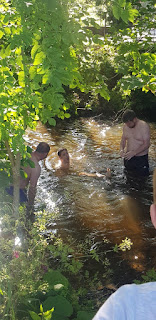
Waving, fishing, thriving but not drowning.
Introduction.
Hi Counsellors, Mentors, Coaches, Change Agents, Leaders, Next Stage Radicals, it’s me with my water metaphors... again.
I’m afraid of drownings in these turbulent seas of Covid, Consumer Shortages and Climate Change. I fear the swirling C's of chaos and catastrophe. So, I need to check out my analysis and some ideas that maybe help us improve our approaches being helpers.
I often quote Jack Nicholson’s character to his counsellor in “As good as it gets”,
“Hey, I’m drowning here and all you’re doing is describing the water!”

https://youtu.be/Y2eKJNK00so
Seeing this clip nudged me to move on from nagging people like me ( us? ) infuriating colleagues and friends by constantly "describing the water" rather than looking to find ways to take helpful, positive action. I'm especially concerned that people like us, charged with being the helpers, are now waving, not yet drowning. Many of us are struggling to cope too.
Background
It’s clear that, in almost all sectors, morale is very low and pressure very high. My recent conversations with several specific colleagues, in the NHS, Civil Service, Education and Business, and then more generally, plus reading the news and social media, suggests we are in deep churn (when a surfer is under the water, unable to breathe, or know which way is up to air - when organisations are under huge pressure and unable to do the basics, let alone develop)
It’s clear that, in almost all sectors, morale is very low and pressure very high. My recent conversations with several specific colleagues, in the NHS, Civil Service, Education and Business, and then more generally, plus reading the news and social media, suggests we are in deep churn (when a surfer is under the water, unable to breathe, or know which way is up to air - when organisations are under huge pressure and unable to do the basics, let alone develop)
"I’m stuck in a rut of, overwork, tiredness and feeling somewhat disillusioned environmentally, politically and at work..." (Chair of a Council)
“On top of this...personally, I’m juggling a mid-career, mid-life crisis with heavy family and financial responsibilities too… it is affecting my health”. (Civil Servant)
In a statement of the bleeding obvious, all of us have personal issues including health, relationships, finances. Each work team has their specific needs too. On top of these will be the organisational expectations, often Government and finance determined. And with the C's seemingly unabated, how can we helpers prepare colleagues and friends to surf these waves of rising pressures, increased needs and wants and begin to find coherent sets of issues to address?
We all know that, especially in such turbulent times, the need to develop, adapt, change and improve continues…indeed it may well need to increase, to cope with the perfect storms. This is all predictable but is the increased helplessness, self-preservation and survival mood of colleagues, leading to a push back against the development activity we are asked to lead? Any development activity?
"Oh no...not you again…. .look we are SO BUSY... we’re only just keeping our heads above water.. .... we can't cope with all this transformational change stuff… it will just have to wait..."
(Department Lead Consultant - normally a keen change agent - quoted by NHS Trust Improvement Director)
The real fear, shared by those I have been talking to, is that many, who were once effective advocates, leaders for change, are themselves tired out, stressed, even ill. Is this a new reality, facing those trying to implementing transformational change during tough times of churn? Are we helpers too experiencing a critical increase in learned helplessness and hopelessness ourselves? Tell me if I am catastrophysing. I do remember being somewhere like this before.
I remember a School Improvement colleague going into a Special Measures, so called, “Failing" School, and facing a room full of demoralised faces. He suddenly realised they were expecting, when he overheard,
“Yet, another bollocking from another prat, who has no idea of what it’s like working here, almost certainly couldn’t hack it anyway and, has obviously escaped front-line pressures years ago”
But what really irked him was being given a motivational thump on the back by the Director of Education,
“Go in and work your magic, inspire them, motivate them, like you always do!”
It was a genuine attempt to fire him up, just once more, but it had the opposite effect. But they could all leave the school site and go into what we now refer to as a normal world. How does that feel when the "new normal" is a world of increasing Covid and Climate Emergency?
In short, I fear the weaker, those charged with rescuing are, they won't be waving but drowning and will be useless as rescuing. This calls for well judged and modified points and natures of intervention. Our clients need by someone energy enough to DO something rather than describing the water, the dead, the drowning and the waving.
What might we do?
What might we do?
How do we thrive in order to “create the permitting circumstances” for change, when morale is so desperately low? The priority has to be looking for strategies to help the helpers because if they ( we? ) are tired, weak and helpless, who will be there to help the most vulnerable, those we normally lead, inspire and nurture?
A recent discussion of these fears with an international group of colleagues, all keen helpers, “The Next Stage Radicals” seemed to suggest they too saw these fears and we began to tease out some thoughts.
Some stressed the critical starting point, for many of us commissioned to seek improvement, is to remind ourselves to work from “Where they are”, as individuals and teams, rather than take on the mantle of yet another who goes in to suggest ideas or worse, “hector them about where they should be”. We agreed that creating the right circumstances for even thinking about development and change has to be a fine balance between listening and developing an honest understanding of the specific individual and team's current conditions and, only then, seeking a realistic set of explorations about what a more desired state of affairs might look like.
So, we felt, unless we show acceptance of individual views and respect differences, we will be greeted with a wall of cynicism, distrust, even fear. Cynicism is an understandable bastion against any extra work that “feels false”, especially if it parades itself in complex terminology and, as a cynical colleague observed, "endlessly circular diagrams". This becomes hopeless when it comes on top of waves of cuts, an already excessive workload and staff shortages.
My personal warning. I well remember dealing with an apoplectic staff team who had felt their "Well-being training day" had been an utter, and complete, waste of time. Later, I was surprised by serious twitter pile-on when I suggested that well-being was far more than handing out happy bags and smiley badges and promising "one evening a week with no work to take home". I was arguing for a genuine reappraisal of the ways work was allocated and how we could reduce workload. Any new leader, change agent or, heaven help them, those who carry the label “consultant”, who leaps in keen, energetic and optimistic spouting about opportunity in adversity maybe deserves the silent derision and deep resentment, they get. We all have to be uber-sensitive, emotionally alert, thoughtful.
Some maybes…. (offered in the hope they may coalesce into strategies)
FIRST, maybe counterintuitively, it might mean us soorting the pressure SYMPTOMS as a priority and leaving the longer term transformational stuff for later. So, to start, it's going to be about ensuring that those of us still with strength, survive ourselves. We have to regroup and stop ourselves just describing the water and wringing our hands...if only because it infuriates. We have to rethink too - we can't keep doing what we did before. We have to set about rescuing and sustaining our strongest, closest, change-agents, those who are still waving. Yes, it will be about throwing in life-lines, life-belts - anything that floats - especially good ideas.
“I’m doing shifts on the wards to ease the pressure - because that’s what they need” (NHS Trust Improvement Director)
“I run several 4 hymn assemblies - to give staff some extra prep time” (Headteacher)
In metaphor mode it’s about pulling them out of the water, drying them off, making them warm, helping them thrive. Only when they have the strength to help others, will they be able to get on with their day job and maybe be ready to properly prepare for transformational change activities.
Extending another water metaphor, it’s not either eating a fish or learning to fish - it’s more sensible to cook them a fish meal, so they are sustained, and only then, judging when they are in a state of readiness to learn how to fish.
This reminded me of, “reading readiness” that state young children move into when the groundwork of storytelling and letter shapes has been grasped and a real desire to read drives them to read. It is impossible for them to become readers until they are in readiness. It’s even more difficult to teach reading to 14 and 15 yr olds, who missed their readiness the first time around, but it can be done, we did it. Maybe “change readiness” is the similar state we need to achieve and yes, it is likely to be most difficult with those who have been around the block a few times and are especially tired. But we have to believe it is never impossible. A colleague told me that flogging dead horses is not cruel, but that flogging dying horses is, so he said, "Tell them to lay off and give me some recovery space".
As we approach that point of change readiness, not a minute before, it will be about digging out, discovering and sharing practical, universal, proven approaches that will really help, and tailoring these for our local rescuers to use, in their specific settings. We all know that the basic skills of helping: facilitation, empowering, coaching, respecting and listening - all sharpened and honed, with emotional intelligence - help us uncover and meet individual need. But in a crisis there is a magnetic and urgent pull to quick action - resisting quick fixes is hard but often necessary. We have to take it slow.
SECOND, as we sense our newly sustained change agents are becoming re-empowered to take over the rescuing and seeing to their colleagues, maybe they need to see us standing back a little, looking at the water and, rather than just describing it again, seeking to involve colleagues fully in identifying the CAUSES, of the symptoms that have to be addressed.
Back to the water metaphor it's now about going upstream and looking for: the causes of the flood; how to stem the flow, and maybe challenging those who threw us, and our colleagues in? It's at this point that more sophisticated but still bespoke approaches like systems thinking, forensic financial reviews, studying psychologically informed environments and critical incident analysis may be useful. What is certain is the urgent need for some early improvements, ideally visible, tangible, meaningful and broadcast widely. These should go to the the heart of purpose. We will also need to be consensual as we create solid plans to properly challenge the lack of thought manifest in the "unintended consequences" that caused the turbulence and failed to sort the causes that got us into these crisis situations. We also need to apologise, profusely and openly for any of our work that failed to help as the waters rose and promise to do better immediately. We are all judged by what we do, nit what we say.
Conclusion
In times of great pressure, even crisis, it’s crucial we look after our people first. So, a respect for and consideration of their wants and needs “For me” is first: (keep fit; eat well; get relationships right). Then, only when we/they are ready for change, can we move on to considering wants and needs “for us”: (supporting and caring for those closest; at home and in work teams and identifying our ideas about better future conditions). Only then, if enough energy remains, can we move on to consider the expectations, hopes and requirements, “for everyone”: (in the organisation; community; society and world.) It’s here we must feed in a realistic view of organisational and government expectations and demands. They have to be faced. They might be finessed. They can't be ignored. But beware of raising them too soon!
Paradoxically, the priority often left to last is the one we all must all care about most, “for everything”: (our Earth’s climate change, its warming, melting ice-caps, depleted environment, flora and fauna,) There is a strong and growing sense of extinction around and that consciousness is depressing and weighing down colleagues who care. Some are still denying, others are rebelling, most are despairing,
So, part of this is about asking ourselves and each other, “What is the point of getting the hospital, school, our business, neighbourhood, community and charity functioning better, only for it to be swept away in a hurricane, fire, or flood? What can we do, whilst we are thinking about our immediate future?
For too many, in 2021, the rising waters are literal and no longer metaphorical.
John Pearce October 2021